


iPhone 15 Pro -130/650 Newtonian reflector and a 10 mm eyepiece (65×).
What Can You Actually See Through Your First Telescope?
Can you see Saturn’s rings from your garden? Yes. A small telescope can also show you shadows inside lunar craters, moons orbiting Jupiter and the pale glow of the Orion Nebula. What often surprises a first-time observer is the difference in scale. The Moon can fill much of the eyepiece, while Saturn looks tiny even when its rings are clearly visible.
This guide uses two telescopes as examples: a 130/650 Newtonian reflector and a 127/1500 Maksutov. The first number is the telescope’s aperture in millimetres. The second is its focal length. To find the magnification, divide the telescope’s focal length by the eyepiece’s focal length. A 10 mm eyepiece in the 130/650 gives 65×. The same eyepiece in the 127/1500 gives 150×.
The Moon: look where the shadows fall
A half-lit Moon is a good place to start. Follow the line where the bright surface meets the darkness. This is the terminator, where the Sun sits low in the lunar sky. Along this line, you can often see a bright crater rim surrounding a floor still deep in shadow. Sometimes a mountain peak catches the sunlight while the ground around it remains dark.
To find your own crater, start with a 25 mm eyepiece. In the 130/650 telescope, that gives 26× and a wide view of the Moon. Centre a crater near the shadow line, switch to the 10 mm eyepiece for 65× and refocus. If you photograph it, line up the phone’s main camera with the eyepiece using a phone holder. Lower the exposure until you can see shades of grey even on the brightest ground.
Try returning to the same crater the following evening. As sunlight reaches farther across its floor, the change in shadow can make the crater look surprisingly different.
Saturn: how big will the rings look?
To the naked eye, Saturn looks like a steady point of light. Through a 127/1500 Maksutov with a 10 mm eyepiece, it becomes a small disc at 150×. Look closely at either side of the planet. The rings extend beyond the disc, and their apparent tilt changes over the years. When we see them nearly edge-on, they can look like a fine line passing across the planet.
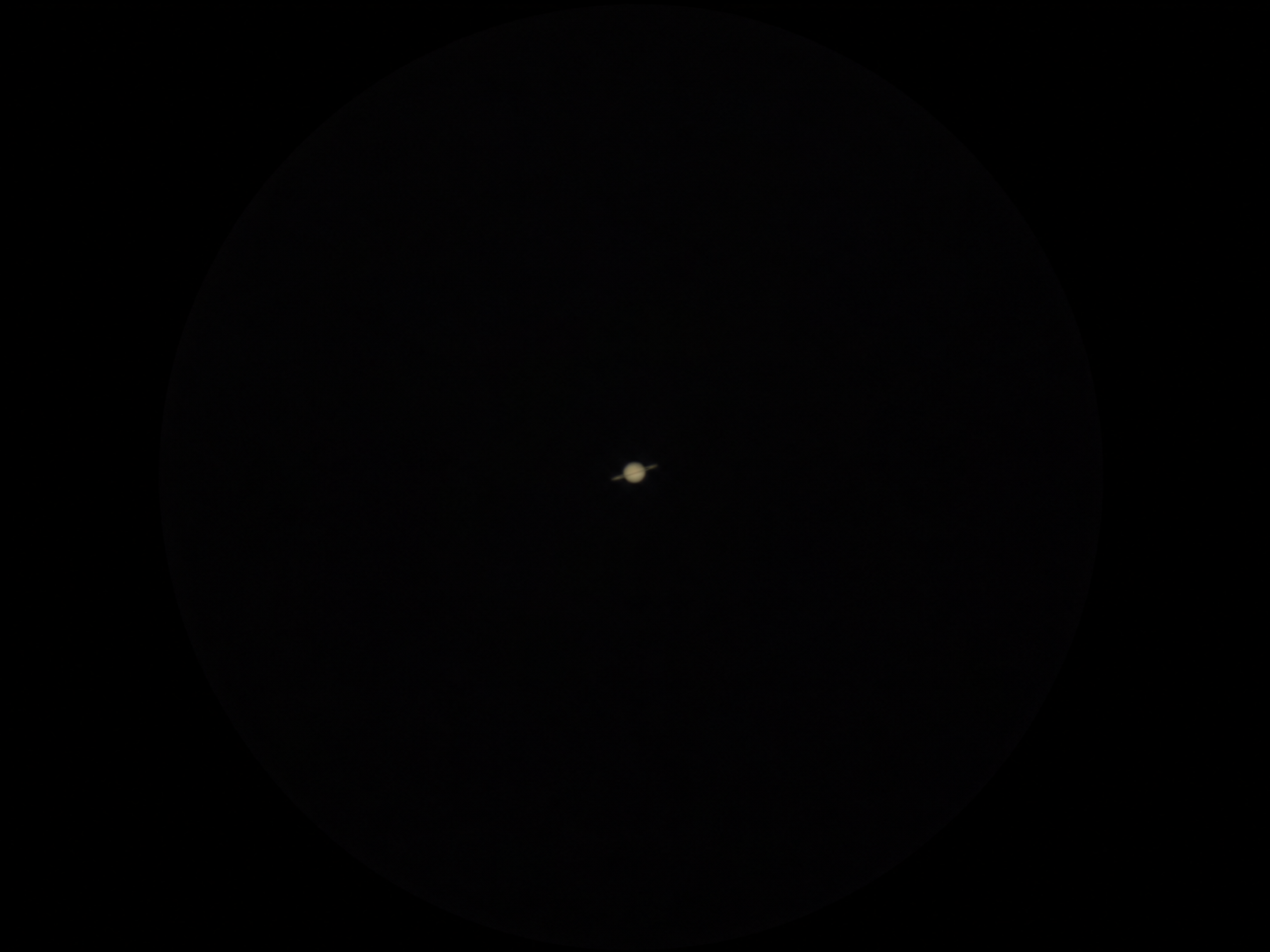
iPhone 15 Pro - 127/1500 Maksutov and a 10 mm eyepiece (150×)
At the eyepiece, give yourself a minute. Moving air can make the planet appear to ripple, then settle long enough for the outline of the rings to sharpen. To capture that moment with a phone, centre Saturn, reduce the exposure until the disc and rings are distinct, and record a short video. You can then select the clearest frame.
Jupiter: watch its moons change places
With a 25 mm eyepiece in the 127/1500 Maksutov, Jupiter appears as a bright disc at 60×. Before looking for detail on the planet, glance to either side. Several tiny points may be arranged almost in a straight line. These are Jupiter’s largest moons. You might see all four, although one or more can be hidden by the planet, lost against its bright face or eclipsed in its shadow.
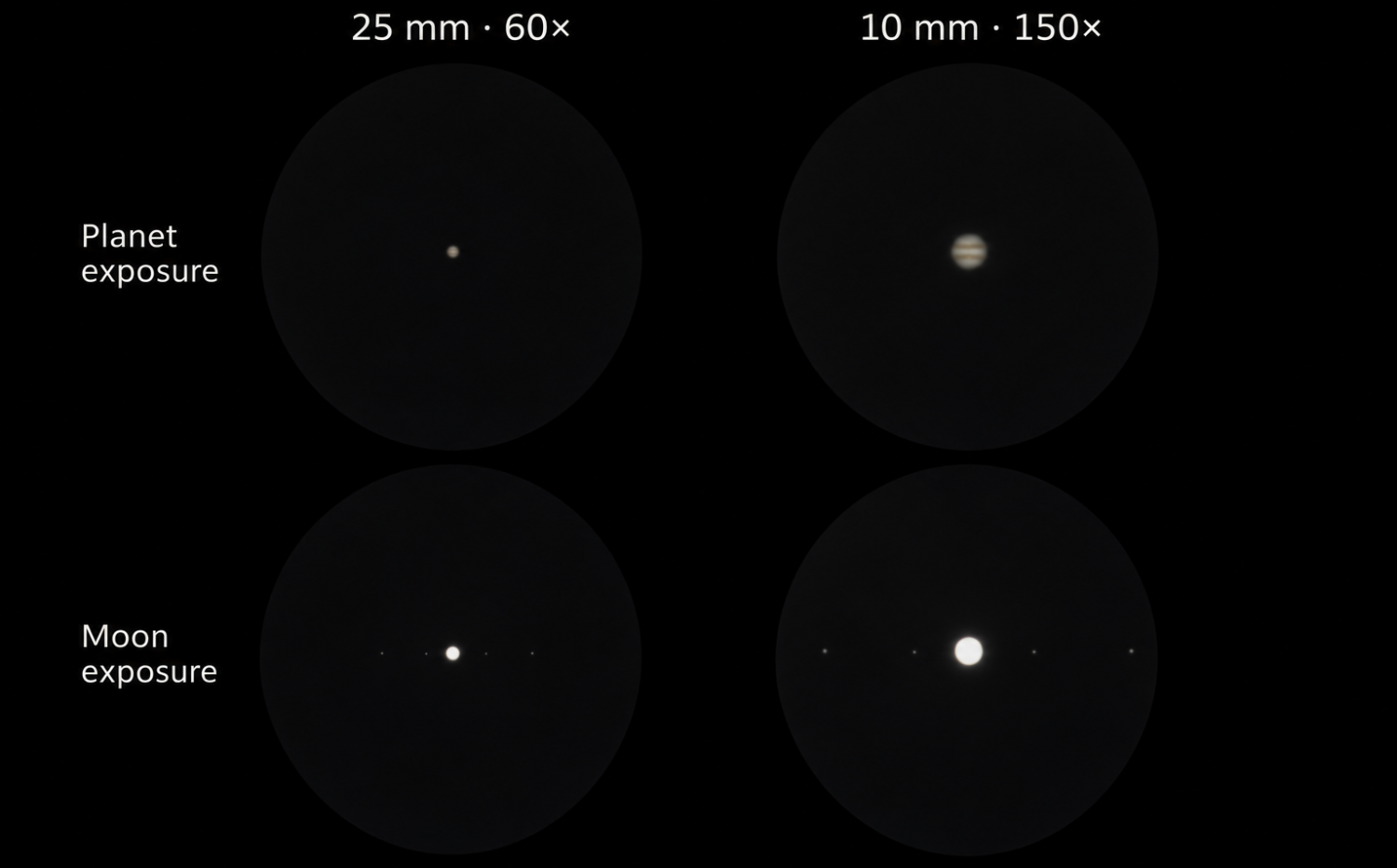
iPhone 15 Pro - 127/1500 Maksutov with a 10mm (150x) and 25 mm eyepiece (60×).
If you want to photograph the moons, keep enough sky on both sides of Jupiter and adjust the exposure until the faint points show up. Jupiter itself may appear white at that setting. For a different shot, lower the exposure and try to capture the two darker cloud belts across the planet.
There’s also a simple observation you can make without a camera. Draw a circle for Jupiter, add a dot for each moon you can see and write down the time. Look again a few hours later. Can you tell which moon has moved?
The Orion Nebula: what your eye sees and what a camera records
On a clear winter evening in Europe, find the three stars of Orion’s Belt. Below them hangs a shorter line of lights known as Orion’s Sword. Aim the 130/650 reflector with a 25 mm eyepiece at the middle of the Sword. At 26×, look for a pale grey glow surrounding a small group of stars. That glow is the Orion Nebula.
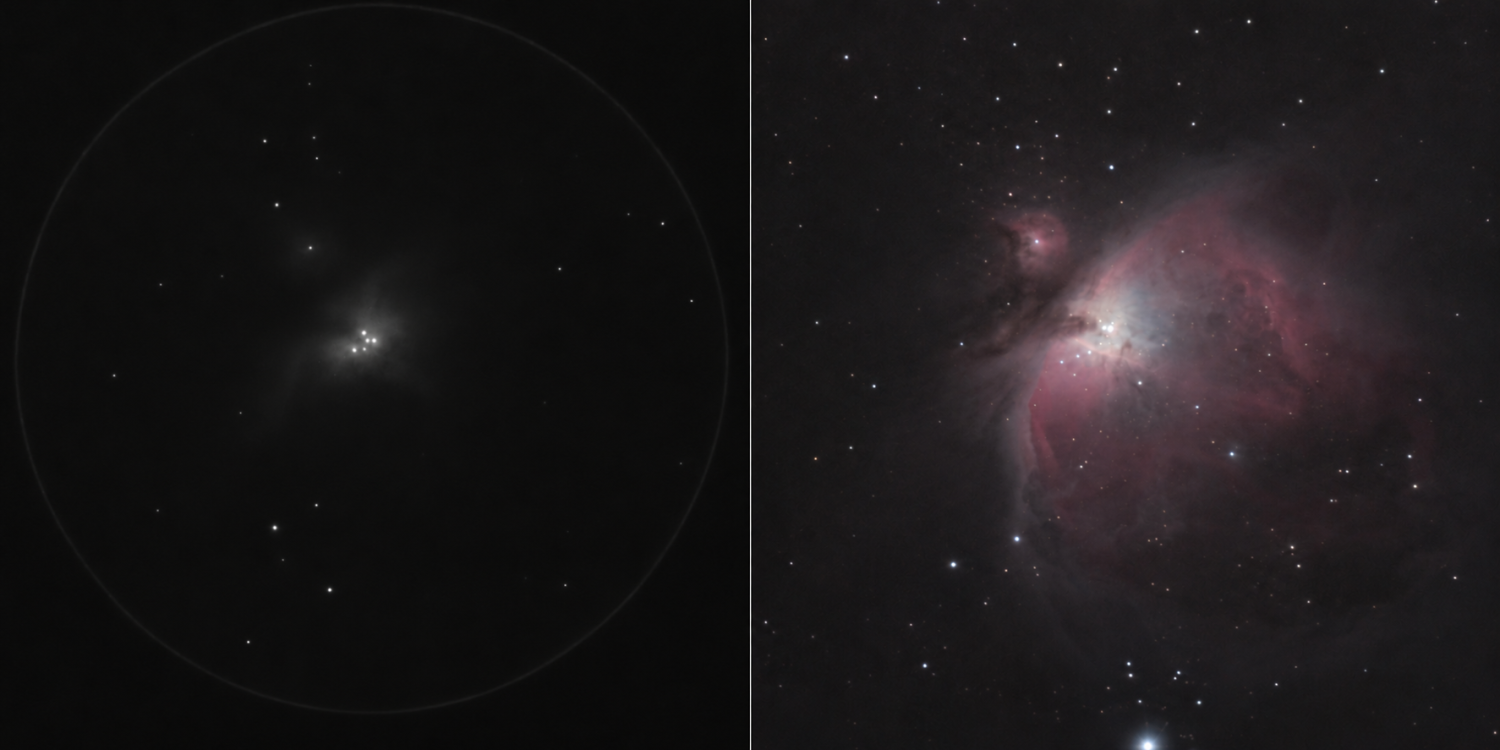
Left: 130/650 reflector with a 25 mm eyepiece (26×). Right: the same nebula in a stacked colour image from a Seestar S30 Pro smart telescope, using its built-in camera.
From a city, the bright centre may be the easiest part to see. Under a darker sky, let your eyes adjust and look slightly to one side of the centre. You may begin to trace faint, wing-shaped wisps extending into the surrounding darkness.
The colour photograph is made differently. The Seestar’s built-in camera takes a series of exposures, and the telescope’s software combines them. As light accumulates, the image reveals colour and faint gas that your eye struggles to detect. A sketch made at the eyepiece is a good way to record just how far you could follow those wisps yourself.
What this means when choosing your first telescope
The 130/650 reflector and 127/1500 Maksutov have nearly the same aperture. Put the same 25 mm eyepiece in both, though, and the reflector gives you 26× while the Maksutov gives you 60×. If you enjoy finding your way through star fields and seeing a nebula in its surroundings, the reflector’s wider view is useful. If lunar craters and planets are what draw you outside, the Maksutov makes it easy to reach higher magnification with a comfortable eyepiece.
For your first clear night, choose one thing to look for: the sunlit rim of a lunar crater, the tips of Saturn’s rings or a moon beside Jupiter. A small detail is much easier to find when you know where to look.
Sky-Watcher Skymax-127 AZ-GTi | Wi-Fi GoTo Telescope | teleskopiem.lv
Sky-watcher Explorer-130P SynScan AZ GO2 telescope | teleskopiem.lv
ZWO Seestar S30 Pro Smart Telescope – Automatic Astrophotography 4K Camera | teleskopiem.lv
Celestron NexYZ Smartphone Adapter – Universal Digiscoping Adapter | teleskopiem.lv


